
I know we mentioned it briefly in our post earlier this week about the design update to the Crimespotting project, but I’m so excited about how the project relates to day vs. night that I want to address it a little more directly:
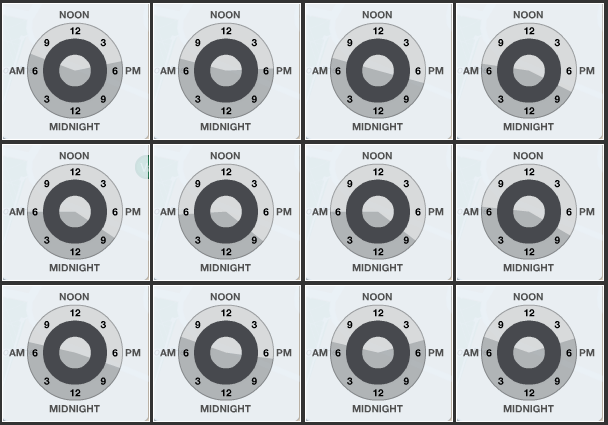
It’s pretty good: you can view crimes by time, turning hours on and off one by one, or using a couple different settings: morning commute, happy hour, police swing shift, etc. So that’s good, and better than what we had before (and most of what else I’ve seen online). But!
I’ve looked under the hood at how a few police departments look at crime, and from what I can tell, most of them use a pretty straightforward mechanism for looking activity in there area, based on the three shift system: day shift (8am to 4pm), night shift (4pm to midnight), and swing shift (midnight to 8am). Reports will say “crime is up on the night shift this month,” things like that. It seems to be institutionalized enough an approach that Mike told me about an urban myth where, since the cops at 4pm are either driving back to or leaving the station, you can commit any crime you want between 3:45 and 4:15 pm and there’s nothing they can do about it! (snickers, passes doob)
In any event there doesn’t seem to be much out there that takes into account not only the time that a crime has happened, but also how light it was outside. It feels intuitively correct that more crime happens when it’s dark, and we didn’t really have a way to figure this out on an ongoing basis, until now. Each of the images above is from a different month in 2008, and you can see that the amount of time that it’s dark and light changes over the year. And selecting “day” or “night” in the interface will do something different in May than it does in December, since there’s more light in May. And this potentially has an impact on how you view crime over time, at least I think it does.
I’m imagining a Gladwellian situation where, in a stroke of brilliant intuitive analysis, standard crime thinking is upended, as a bright splash of crime emerges out of the data relative to twilight over the year, not time of day… Anyhow, someone hit the Crimespotting API and figure that out, wouldja?
I love working here!